

Warsaw History Museums: From World War II to the Cold War
Freedom Years Travel contains affiliate links. If you make a purchase using one of the links below, we may receive compensation at no extra cost to you. We only recommend products and services we use and trust. Read our disclaimer for more information.
Warsaw is one of Europe’s most compelling cities for exploring 20th-century history. Few places experienced such dramatic upheaval—from the devastation of World War II to decades under communist rule and the remarkable rebirth that followed. The city’s museums tell this story with depth and emotion, offering insight into both Poland’s national struggles and the resilience of its people.
In this guide, I highlight the museums that best bring Warsaw’s 20th-century story into focus. Expect immersive exhibitions, powerful memorials, and displays that stay with you long after you leave. You’ll encounter stories of extraordinary courage, the stark realities of life behind the Iron Curtain, and confronting reminders of humanity at its worst.
If you’re planning a broader trip, you might enjoy my 9 Best Things to Do in Warsaw or 10-Day Poland Itinerary for First-Time Visitors. And for more insights into Poland’s wartime history, my post on Visiting Auschwitz provides practical advice for a deeply moving day trip.
Understanding Warsaw Through Its 20th-Century Museums
Few cities reflect the turmoil of the 20th century as vividly as Warsaw. By the war’s end, an estimated 85–90% of its buildings lay in ruins, a testament to the systematic effort to destroy the city. Entire districts were methodically razed during World War II; yet, soon after, Warsaw rose again, painstakingly rebuilt from the ashes. Today, the city’s museums trace that extraordinary arc — from occupation and resistance, to near-annihilation and, finally, renewal.
Visiting these museums isn’t just about viewing artefacts. Poland excels at creating immersive, thoughtfully designed spaces that draw you into the stories that shaped modern Warsaw. You’ll confront the realities of the Warsaw Ghetto, the bravery and sacrifice of the Uprising, and the restrictions and surveillance that defined life under communist rule. Together, these museums offer a powerful, deeply engaging introduction to the events that shaped Warsaw’s character and identity.
Practical Tips for Visiting Warsaw’s History Museums
Exploring Warsaw’s 20th-century history can be deeply moving, often complex, and occasionally overwhelming, so a little planning makes the experience far more rewarding.
Most museums are well connected by public transport, and a 24- or 72-hour travel pass is an easy way to move between them by tram, bus or metro. Several sites sit close together — such as POLIN and Pawiak — making them easy to visit on the same day.
Many museums offer free entry on selected days or reduced-price tickets for seniors, so it’s always worth checking their official websites before your visit. Pre-booked tickets are recommended for major sites like the Warsaw Rising Museum and POLIN, which can get busy, especially in high season.
Audio guides are widely available, sometimes included in the ticket price, and usually come with pause functions that let you explore at your own pace. Allow at least two to three hours for major museums, and around 45 to 90 minutes for smaller or more specialised sites.
Cloakrooms or lockers are common, though some require a small coin deposit, and most museums provide seating throughout the galleries — helpful if you prefer a slower pace.
Finally, be aware that many exhibitions contain confronting material related to war, occupation and political persecution. I found that one major museum per day was enough — both emotionally and mentally — as there is a great deal to take in.
Museum Locations in Warsaw
If you prefer to map things out in advance, I’ve included a Google My Maps with all the museums featured in this post. It’s a handy tool for understanding how Warsaw’s history is spread across the city and for planning your days without doubling back.
World War II Museums in Warsaw
Warsaw Uprising Museum
Few museums in Europe match the emotional impact of the Warsaw Uprising Museum. Officially known as the Warsaw Rising Museum, it is dedicated to the 63-day rebellion of 1944, when the Polish Home Army rose against Nazi occupation—one of the most tragic and heroic chapters in modern Polish history.
From the moment you enter, the museum is completely immersive. Eyewitness interviews, reconstructed scenes and powerful imagery guide you through the early days of hope and into the unimaginable hardship that followed. The courage displayed by the insurgents is almost beyond comprehension, as they fought against impossible odds with extraordinary determination.
You’ll hear accounts of children and teenagers serving as couriers, insurgents navigating the city’s sewers to move between districts, and families surviving severe shortages of food and water. There are filmed interviews with pilots who risked their lives to drop supplies over the besieged city, and with a soldier conscripted into the German army who recounts the mass murder of civilians. The museum also confronts the treachery of the Red Army, which halted its advance and watched the city burn rather than support the uprising.
A 3D film, shown from a pilot’s perspective, reveals the scale of devastation — more than 80% of Warsaw reduced to rubble by the end of the war. It’s an unflinching yet essential experience for anyone seeking to understand Poland’s wartime resilience.
Practical Tips
There is a café and restrooms halfway through if you need a break, and I strongly recommend storing your hand luggage in the lockers at the entrance to make the visit more comfortable.
Plan Your Visit to the Warsaw Rising Museum
Day |
Opening Hours |
Standard Ticket Price |
|
Monday |
10am – 6pm |
35 PLN |
|
Tuesday |
CLOSED |
N/A |
|
Wednesday |
10am – 6pm |
35 PLN |
|
Thursday |
10am – 6pm |
FREE |
|
Friday to Sunday |
10am – 6pm |
35 PLN |
Please note that opening hours and ticket prices can vary, especially on weekends and public holidays. It’s always worth checking the museum’s official website before your visit for the most up-to-date information and any discounted ticket options.
📍 Grzybowska 79, Warsaw
🇵🇱 Muzeum Powstania Warszawskiego
🎧 Audio guide available for 13 PLN
⌛ Allow 3 hours.
🌐Warsaw Rising Museum


POLIN Museum of the History of Polish Jews
The POLIN Museum is one of the most important museums in Warsaw and an essential stop for anyone interested in Jewish history in Warsaw. While it covers 1,000 years of Jewish life in Poland, its strength lies in the detailed, emotionally powerful account of Warsaw’s Jewish community before, during, and after World War II.
The early galleries explore how Jewish people settled in medieval Poland and helped shape the country’s cultural and economic life. Interactive displays and beautifully recreated wooden synagogues bring centuries of daily life and tradition to life. As the exhibition progresses, rising antisemitism and foreign occupation form the backdrop to the devastating events of the 20th century.
The final sections, focused on the Warsaw Ghetto and the 1943 uprising, are particularly moving. A reconstructed ghetto bridge, staircases engraved with lost street names, and first-person testimonies offer a vivid sense of both the suffering and courage found within the ghetto walls.
Practical Tips
Practical Tips
The free audio guide is excellent and provides helpful structure as you move through the galleries. Fold-up stools are available and there’s an on-site café serving traditional Jewish dishes. I spent almost three hours here and could easily have stayed longer. The museum entrance faces the Monument to the Ghetto Heroes, a significant site of remembrance.

Plan Your Visit to the POLIN Museum
Day |
Opening Hours |
Standard Ticket Price |
|
Monday |
10am – 6pm |
45 PLN |
|
Tuesday |
CLOSED |
N/A |
|
Wednesday |
10am – 6pm |
45 PLN |
|
Thursday |
10am – 6pm |
FREE |
|
Friday |
10am – 6pm |
45 PLN |
|
Saturday |
10am – 8pm |
45 PLN |
|
Sunday |
10am – 6pm |
45 PLN |
📍 6 Mordechaja Anielewicza Street, Warsaw
🎟️ Tickets available online or on-site
🇵🇱 Muzeum Historii Żydów Polskich POLIN
🎧 Audio guide included with ticket price
⌛ Allow 3 hours.
🌐POLIN Museum
🎟️ Book POLIN Museum Tickets Online
If you prefer having your museum tickets stored digitally, POLIN Museum tickets are available through GetYourGuide. It’s an easy way to keep everything in one place, and most bookings include free cancellation up to 24 hours before your visit.
Discover the Former Warsaw Ghetto with a Local Expert
If you’d like to explore the area around Muranów and gain a deeper understanding of the Warsaw Ghetto, two excellent guided tours start close to POLIN.
🚶Warsaw Ghetto Private Walking Tour
A highly personal experience that takes you to surviving fragments of the ghetto walls, the last remaining ghetto street, and the only synagogue in Warsaw to survive the war.
🚶♀️🚶♂️Jewish History Guided Walking Tour (Group Tour)
A more affordable option that follows a similar route, covering key sites tied to Jewish life and the Holocaust.
Both tours complement a visit to the POLIN Museum and helps bring this part of Warsaw’s 20th-century story into sharper focus.
If you’d like to explore with an expert, you can check availability for each tour using the links above.


Museum of Warsaw
Housed within a series of carefully reconstructed townhouses on the Old Town Market Square, the Museum of Warsaw offers a clear, well-structured look at the city’s past — particularly its near-total destruction during World War II and the immense effort that went into rebuilding it. The permanent exhibitions use detailed models, artefacts, and archival film to show how Warsaw was reconstructed step by step. At the top, an observation deck provides sweeping views over the Old Town, giving helpful context to everything you’ve just learned.
Practical Tips
The visit begins in the basement, where the story of Warsaw’s development, destruction, and post-war reconstruction is introduced. Before you leave, be sure to head up to the observation deck for views over the Old Town Market Square and the rooftops of both the Old and New Towns.
Plan Your Visit to the Museum of Warsaw
Day |
Opening Hours |
Standard Ticket Price |
|
Monday |
CLOSED |
NA |
|
Tuesday, Wednesday |
9am – 5pm |
25 PLN* |
|
Thursday |
9am – 7pm |
FREE |
|
Saturday, Sunday |
11am – 6pm |
25 PLN |
*Core Exhibition Only
📍 Old Town Market Square, Warsaw
🎟️ Tickets available online or on-site
🇵🇱 Muzeum Warszawy
📱 Free MP3 Audio guide — bring your own phone + earphones OR
🎧 Rental device — 10 PLN on site
👀 Observation terrace: Free with museum ticket; 10 PLN if visiting terrace only
⌛ Allow 1.5-2 hours.
🌐 Museum of Warsaw
Pawiak Prison Museum
For anyone tracing Warsaw’s World War II history, the Pawiak Prison Museum provides essential context on the brutality of the Nazi occupation. Originally a 19th-century tsarist prison, Pawiak was taken over by the Gestapo in 1939 and soon became one of the most feared sites in occupied Poland. Tens of thousands of people passed through its gates — resistance fighters, political prisoners, Jews, and civilians accused of even minor anti-German activity. Many were tortured, executed, or transported to concentration camps.
The museum incorporates what remains of the original prison, combining reconstructed cells with personal items, documents, and photographs to show how prisoners lived and died here. The memorial courtyard, with its symbolic Pawiak tree, honours the victims and provides space to reflect on the scale of the suffering.
Conditions were notoriously harsh: overcrowded cells, starvation-level rations, routine torture, and frequent executions. Pawiak became a key part of the Nazi terror system in Warsaw, and understanding its role helps round out the picture of life under occupation.
Plan Your Visit to Pawiak Prison Museum
Day |
Opening Hours |
Standard Ticket Price |
|
Monday |
CLOSED |
NA |
|
Tuesday |
10am – 5pm |
20 PLN |
|
Wednesday |
11am – 7pm |
20 PLN |
|
Thursday |
10am – 5pm |
FREE |
|
Friday to Sunday |
10am – 5pm |
20 PLN |
📍 ul. Dzielna 24/26 00‑162 Warsaw, Poland
🎟️ Tickets available on-site
🇵🇱 Muzeum Więzienia Pawiak
⌛ Allow 30-45 minutes.
🌐 Pawiak Prison Museum
Mausoleum of Struggle and Martyrdom
The Mausoleum of Struggle and Martyrdom — often referred to in wartime accounts simply as Szucha — preserves the former Gestapo interrogation centre on Aleja Szucha much as it was left after the war. It’s a small museum, but the atmosphere is powerful from the moment you step inside. The original cells and interrogation rooms remain intact, with scratched messages and inscriptions left by prisoners awaiting questioning.
Szucha functioned as the main interrogation site for detainees transferred from Pawiak Prison, just a few kilometres away. Most prisoners were questioned here before being sent back to Pawiak for further imprisonment, execution, or deportation to concentration camps. Visiting both sites together gives a clearer sense of how the machinery of repression operated in occupied Warsaw.
The museum combines preserved rooms with simple information panels, as well as touchscreen displays that allow you to explore testimonies and historical context at your own pace. Subtle sound effects and music heighten the atmosphere, making the experience even more immersive. It’s a significant place to visit if you’re tracing Warsaw’s wartime history and want to understand the realities faced by those who passed through Szucha.
Plan Your Visit to the Mausoleum of Struggle and Martyrdom
Day |
Opening Hours |
Standard Ticket Price |
|
Monday |
CLOSED |
N/A |
|
Tuesday |
10am to 5pm |
20 PLN |
|
Wednesday |
11am to 7pm |
20 PLN |
|
Thursday |
10am to 5pm |
FREE |
|
Friday to Sunday |
10am to 5pm |
20 PLN |
📍 al. Jana Chrystiana Szucha 25 00‑580 Warsaw, Poland
🎟️ Tickets available on-site
🇵🇱 Mauzoleum Walki i Męczeństwa
⌛ Allow 1-2 hours.
🌐 Mausoleum of Struggle and Martyrdom
Cold War and Communist-Era Museums in Warsaw
Museum of Life Under Communism
The Museum of Life Under Communism offers a clear, engaging look at what daily life was really like under Poland’s communist regime. The displays includes a reconstructed 1970s apartment, a Fiat 126p, shelves of rationed goods, and the household objects that defined the era. Exhibits highlight both the limitations people faced and the creativity that helped them navigate constant shortages.
While you’re in the area, it’s worth wandering over to Marszałkowska Street and Plac Konstytucji to see some of Warsaw’s most distinctive post-war socialist architecture. This neighbourhood was a flagship project of the post-1945 rebuild, designed to showcase the ideals of socialist urban planning with grand avenues, monumental facades, and housing blocks intended for the “model socialist citizen.”
Plan Your Visit to the Museum of Life Under Communism
Day |
Opening Hours |
Standard Ticket Price |
|
Monday to Thursday |
10am to 6pm |
30 PLN |
|
Friday |
12pm to 8pm |
30 PLN |
|
Saturday to Sunday |
10am to 6pm |
30 PLN |
📍 ul. Piękna 28/34 00‑547, Warsaw – near Constitution Square
🇵🇱 Muzeum Życia w PRL
🎟️ Tickets available online or on-site
🎧 The audio guide is free if you use your own phone and earphones
Or you can hire a traditional Walkman device for 10 PLN.
⌛ Allow 1-1.5 hours.
🌐 Museum of Life Under Communism
🎟️ Book Life Under Communism Museum Tickets
You can also pre-book tickets for the Museum of Life Under Communism through GetYourGuide. Tickets are delivered straight to the app on your phone, and most include free cancellation up to 24 hours before your visit—useful if your travel plans shift.


Palace of Culture and Science
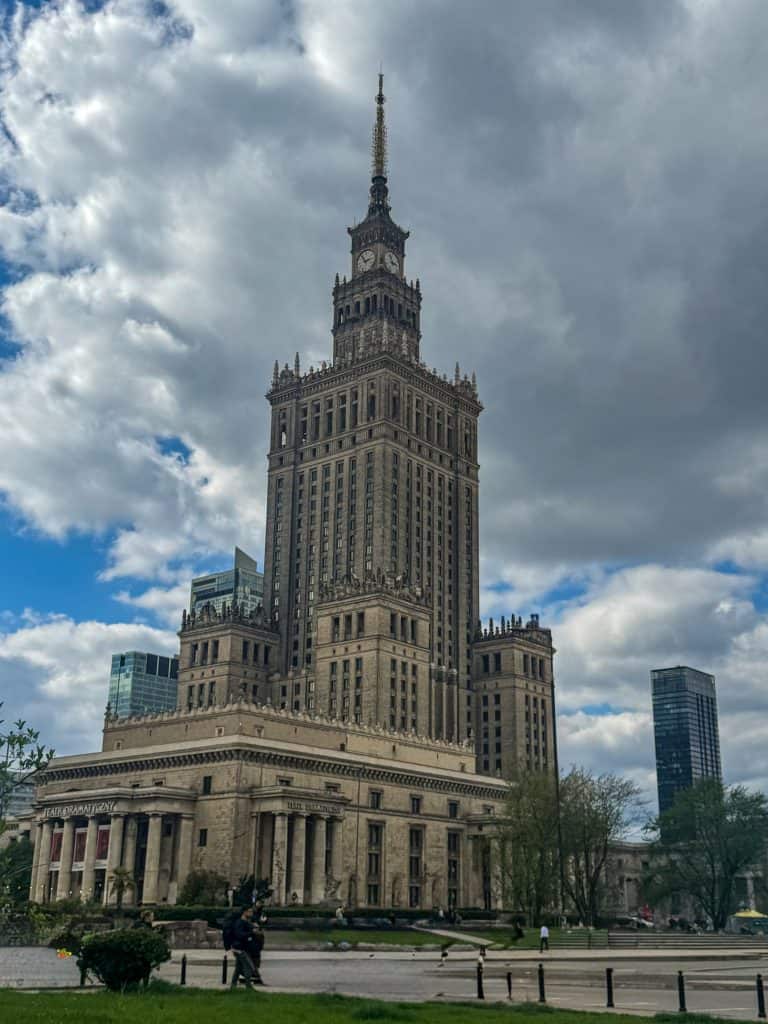
While not technically a museum, the Palace of Culture and Science is essential for anyone interested in Warsaw’s 20th-century history. Built in the 1950s as a so-called “gift” from Stalin, it remains one of the city’s most recognisable—and most debated—landmarks.
To explore inside, you’ll need to book a guided tour through an external operator, as the building itself doesn’t run its own visitor tours. These tours offer valuable context, explaining how the palace was designed as a statement of Soviet power and a tool of communist ideology. You’ll walk through vast marble halls and preserved mid-century interiors while hearing stories about how Varsovians viewed the building during the communist era. Most tours finish at the 30th-floor observation deck, where panoramic views underline how dramatically the city has transformed since the post-war years.
A visit here pairs well with the Museum of Life Under Communism, offering a physical, architectural perspective on the ambitions and contradictions of the era.
Plan Your Visit to the Palace of Culture and Science
📍 Marszałkowska 104/122, Warsaw
🇵🇱 Pałac Kultury i Nauki
🎟️ Tickets to the Observation Deck available online or on-site
🌐 Palace of Culture and Science
🗺️ Guided Tour of the Palace of Culture & Science
If you’re curious to explore behind the scenes, you can join a guided tour of the Palace of Culture & Science, including areas not open to the general public.
Museum of Cursed Soldiers and Political Prisoners of the Polish People’s Republic
Housed within the stark walls of the former Mokotów Prison on Rakowiecka Street, this museum exposes one of the bleakest chapters of post-war Polish history. Under the communist regime, the prison became a major interrogation centre for political prisoners — often the same resistance fighters and soldiers who had helped liberate Poland during World War II. Many were executed here under Soviet direction, their families never told what happened to them.
The English-language tour runs once a day and must be booked in advance. We were the only people on our tour, guided by a young woman whose knowledge and professionalism gave weight to every detail.
We toured the concrete cells where up to a dozen prisoners could be crammed, containing only one exposed toilet that also served as the only source of water. In winter, guards deliberately left the windows open to let freezing air sweep through the building; in summer, the heaters were turned on to make conditions equally unbearable. The prison was known for more than 300 methods of torture, and standing inside those rooms makes the scale of cruelty almost impossible to comprehend.
Solitary confinement was even more disturbing. One cell was so small and completely dark that prisoners could only lie down, cut off from any sense of time or space. It is an experience that is difficult to forget, not because of dramatic displays, but because the original setting speaks for itself.
Practical Tips
Tours need to be booked ahead; I emailed the museum around two weeks in advance to confirm a date and time. We were booked in at 4pm.
Plan Your Visit to the Museum of Cursed Soldiers and Political Prisoners of the Polish People’s Republic
Day |
Opening Hours |
Standard Ticket Price |
|
Monday |
CLOSED |
NA |
|
Tuesday to Sunday |
10am to 6pm |
FREE |
📍 ul. Rakowiecka 37, 02‑521 Warsaw
🇵🇱 Muzeum Żołnierzy Wyklętych i Więźniów Politycznych PRL
🎟️ No tickets required – admission is free
📅 A booking is required for guided tours — via email or phone listed on rakowiecka37.pl
⌛ Allow 90 minutes
🌐 Museum of Cursed Soldiers and Political Prisoners of the Polish People’s Republic

Neon Museum
The Neon Museum offers a lighter, visually engaging contrast to Warsaw’s more somber historical sites. Now located on the 4th floor of the Palace of Culture and Science, it showcases more than 100 restored neon signs and close to 1,000 individual letters from the city’s Cold War era.
In the 1950s and 60s, the communist government launched a “neonisation” campaign to modernise Warsaw’s war-scarred streets. Architects and artists were commissioned to design colourful, eye-catching signs for cinemas, shops and public buildings — a way to project progress and cosmopolitanism at a time when everyday life remained tightly controlled.
It’s a straightforward, enjoyable museum to browse and a welcome change of pace if you’re spending your days exploring Warsaw’s heavier 20th-century history.
Plan Your Visit to the Neon Museum
Day |
Opening Hours |
Standard Ticket Price |
|
Monday – Thursday |
11am – 6pm |
25 PLN |
|
Friday, Saturday |
11am – 7pm |
25 PLN |
|
Sunday |
11am – 6pm |
25 PLN |
📍 Palace of Culture and Science
Main Entrance from Marszałkowska Street; 4th floor
🇵🇱 Muzeum Neonów
⌛ Allow 1-1.5 hours.
🌐Neon Muzeum
✨ Explore Communist-Era Warsaw Beyond the Museums
Step beyond the exhibits and experience the history of the surrounding area with an expert guide:
🚶♂️ Life Behind the Iron Curtain Walking Tour
Trace the everyday realities of Warsaw under communism. See how people adapted to shortages and restrictions with creativity, resilience, and a sense of humor.
👉 Book the Walking Tour
🚗 Warsaw Communism Private Tour in a Retro Fiat
Ride through the city in an iconic Fiat 125p, while your guide shares entertaining stories and quirky facts about daily life behind the Iron Curtain.
👉 Book the Retro Fiat Tour
Final Thoughts on Warsaw 20th Century History Museums
Warsaw’s museums are some of the best places to understand the city’s complex history, especially if you’re interested in World War II, the Holocaust, the Warsaw Rising, or life under communist rule. Each museum covers a different chapter — from the destruction of the Jewish community and the bravery of the 1944 uprising to the realities of daily life in the Polish People’s Republic. Some exhibitions are challenging, but they provide essential context for anyone wanting to grasp how Warsaw was shaped by the 20th century.
If you’re planning a museum-focused itinerary in Warsaw, a little preparation goes a long way. I’ve included practical details, opening hours and ticket information for each site, though it’s always worth checking the official websites before you visit, as schedules, free-entry days and temporary exhibitions often change. With the right planning, these museums offer one of the most rewarding ways to connect with Warsaw’s past — and to better understand the city you see today.
If you’re interested in exploring more of Poland during your trip, you might find my 10-Day Poland Itinerary, 9 Best Things to Do in Warsaw or Poland Travel Costs Guide helpful as well. Warsaw rewards curiosity — and its museums are the perfect place to start.
FAQs for Visiting the Best Museums in Warsaw
The most significant museums for first-time visitors are the Warsaw Rising Museum, POLIN Museum of the History of Polish Jews, and the Museum of Warsaw. Each offers a different perspective on the city’s past.
Most major museums need at least two to three hours. The Warsaw Rising Museum and POLIN often take longer because the exhibitions are extensive and emotionally heavy.
Yes, but some exhibitions deal with difficult topics such as war, occupation, and the Holocaust. Visitors who prefer lighter content may want to balance these museums with outdoor time or smaller local museums.
Many museums allow walk-in entry, but advance booking is recommended for the POLIN Museum and the Warsaw Rising Museum, especially on weekends and holidays.
Almost all major museums in Warsaw include English signage or offer audio guides. Some smaller museums may have more limited translations.
Most museums offer free entry on one day of the week, usually Thursdays. It’s worth checking each museum’s website for up-to-date information.
Children are allowed, but the content can be intense. Families often choose to focus on certain sections or opt for shorter visits.
Warsaw has an excellent public transport system with trams, buses, and the metro. Many key museums are also within walking distance of each other, especially around the Old Town and Śródmieście.
Several museums in Warsaw close on Mondays, so it’s wise to plan your schedule accordingly.
Policies vary. Some museums allow photography without flash, while others restrict it in specific galleries. Staff and signage make this clear as you enter.


